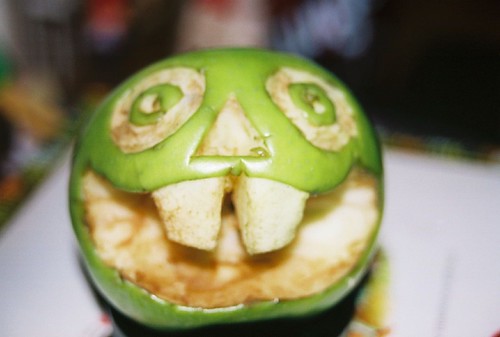
Tuesday, August 30, 2011

Green Kitchen: Chunky Spiced Unsweetened Applesauce

Green Kitchen is a bi-weekly column about nutritious, inexpensive, and ethical food and cooking. It’s penned by the lovely Jaime Green.

I'd like to take a moment to think on the lessons of zucchini.

I greet the first greenmarket zucchini with excitement – just like every vegetable's first seasonal appearance, this is a momentous occasion. Fresh and bright and less than $2 a pound, I take them home in big bundles, sauteeing them simply for the sweet zucchini flavor.

Fast-forward to August and we're like, Uggh, please, no more zucchini! I know you are cheap, summer squash, but I am sick of you.

Friends, let us not let the apple fall prey to the same late-season disenchantment.

We must take action now, at the start of apple season, to ward off an early winter apple fatigue. Apples, like zucchini, are cheap. They are delicious. They are healthy. But they also survive storage really, really well, and will still be around in cheerful piles come, like, February. Fruit in February! It seems amazing now, but the midwinter farmers market devotee looks at apples like cockroaches after a nuclear winter – their fortitude is admirable, but what you wouldn't give for a delicate berry.

So I say to you now, stop apple fatigue before it starts! Don't binge on raw honeycrisps for the next two months, only to fight tears and a slight gag reflex when they're the only non-potato thing at the greenmarket this winter. Bring to the start of apple season the creativity that usually marks the end of a fruit or vegetable's yearly time, but with excitement and ingenuity rather than bleary-eyed desperation.

We must take advantage of the autumn's apple bounty, lay in stores of this cheap, healthy, delicious fruit, and get creative with it!

Also I've come up with an apple sauce recipe that's really, really good. Like, I just had to take a break from writing about it to go get some from the fridge good.

Awesome things about this apple sauce, other than it being so tasty:
—No sugar! Apples are plenty sweet on their own.
—No milling, grinding, processing, or whatever! This sauce is nice and chunky, which also makes it more versatile than a smooth puree. I've been mixing it in with Greek yogurt all week.
—So cheap! I got my apples for $0.37/lb in a big 4lb bag. Applesauce apples don't need to be pretty, or even the tasty, crisp, sweet apples you'd choose for raw eating. Get 'em cheap.
—It freezes well! I spooned some into a quart freezer bag and used this method for rice-freezing to separate it into individual portions. Come March when the memory of fresh apples grows fond and crappy supermarket produce beckons, I'll have this tastiness stowed away, ready to defrost.
—You may feel like a prairie homesteader while making it, which is silly, because apples are not a prairie thing, but it feels good old-timey domestic. Or maybe that's just me. But it was fun.

(PS: Do plumped-up raisins remind anyone else of Danny, the Champion of the World? God, that book is the best.)

~~~

If you like this recipe, you may enjoy:
All Night Apple Butter
Maple-Ginger Applesauce
Autumn Apple Salad

~~~

Chunky Spiced Applesauce (Unsweetened)


makes approximately 1 quart, or 8 1/2-cup servings

4 lbs apples (about 10 cups chopped)
1 cup raisins
3 tbsp lemon juice
2 tsp cinnamon
1 tsp ground ginger
1 tsp nutmeg
a few dashes cayenne
a dash of salt

Instructions
1. Core and chop the apples. The larger your chunks, the chunkier your sauce. Unevenness is fine, too.

2. As you collect your chopped apples in a large bowl or whatnot, add a tablespoon of lemon juice every few apples. This keeps the apples from browning and is good for the sauce.

3. Heat a large pot over medium heat. Add the apples, stirring to get them all hot.

4. Once the apples start to release some water, add raisins and salt.

5. Cook 20-30 minutes, until apples reach your desired mushiness, stirring every so often. If things look dry, add a half cup of water.

6. Stir in spices; taste. Adjust as necessary.

7. Try not to burn your mouth.

Approximate calories, fat, fiber, protein, and cost per serving:
128 calories, 0.4g fat, 4.1g fiber, 0.9g protein, $0.35

Calculations
4 lbs apples: 567 calories, 1.9g fat, 26.2g fiber, 2.8g protein, $1.50
1 cups raisins: 433 calories, .5g fat, 5.4g fiber, 4.5g protein, $1.19
3 tbsp lemon juice: 3 calories, 0g fat, 0g fiber, 0g protein, $0.04
2 tsp cinnamon: 2 calories, 0g fat, 0.5g fiber, 0g protein, $0.02
1 tsp ground ginger: 6 calories, 0g fat, 0.2g fiber, 0.2g protein, $0.03
1 tsp nutmeg: 12 calories, 0.8g fat, 0.5g fiber, 0g protein, $0.01
a few dashes cayenne: 0 calories, 0g fat, 0g fiber, 0g protein, $0.01
a dash of salt: 0 calories, 0g fat, 0g fiber, 0g protein, $0.01

TOTAL: 1023 calories, 3.2g fat, 33.1g fiber, 7.5g protein, $2.81
PER SERVING (TOTAL/8): 128 calories, 0.4g fat, 4.1g fiber, 0.9g protein, $0.35

Creating a Global Pantry

Exploring a new cuisine can be exciting and intimidating. Flavors and ingredients are sometimes unfamiliar, and the techniques can be tricky. But trying new food is an adventure, and it’s less stressful when you realize that the strange is not so strange at all.

American food is a mishmash of influences, primarily western European: English, French, German, and Italian. We use lots of parsley, oregano, garlic, and onions in our everyday cooking, with a little sage thrown in at Thanksgiving. So do many other cultures.

When I first started cooking Indian food, I was worried that I would blow a week’s pay on spices just to learn a few dishes. Not true. I found after reading a few recipes that I had several of the Indian staple ingredients in my kitchen already. The same was true when I first tried Caribbean and Middle Eastern.

As you can imagine, many spices and/or staples are used in a variety of cuisines--and therefore worth your investment. Dried chilies, cayenne/red chili powder, and cumin make endless appearances across nationalities. If you like fiery, flavorful food, you won’t be sorry you splurged on the big bag of dried chilies. They’ll take you all the way around the world.

Fresh items like garlic and onions are featured in nearly every culture. You’ll almost always need one or both of these alliums. Other chart-topping fresh ingredients are parsely, cilantro, and ginger.

Sure, there are some exotics that are specific to particular regions, and as you advance, you may want to indulge in mango powder and a box of Kaffir lime leaves from the Internet. But to get started, your local grocery, spice market, and ethnic shop are all you need.

To create this list, I read over 200 recipes to cull the most commonly used staple ingredients, primarily spices, of 10 regional cuisines. (I purposefully left out our western European favorites, Italian and French.) Once you have these staples in your pantry, if you don't already, you'll be ready to begin countless culinary adventures, jet-setting around the globe without leaving your kitchen.

The Global Pantry

Mexican/South American
achiote (annato)
corn tortillas
cumin
dried beans
dried chilies (ancho, serrano)
corn meal/masa harina
oregano (Mexican varietal, if available where you live)
rice
Fresh ingredients: chilies (poblano, habenero, and jalapeno), cilantro, epazote, garlic, lemons, limes, onion
Extras: adobo, sazon, recaito
Recipes: Esquites, Fresh Salsas, Quick Red Posole with Beans

Caribbean/Central American
allspice
bay leaf
coconut milk
cumin
dried beans
oregano
rice
thyme
Fresh ingredients: cilantro, garlic, ginger, lemon, lime, onion, Scotch bonnet/habanero peppers
Recipes: Nuyorican Rice and Beans, Gallo Pinto, Jamaican Cook-up Rice with Callaloo

Eastern European
bay leaf
bulgar
caraway seeds
thyme
vinegar
Fresh ingredients: dill, garlic, onion, parsley, sour cream
Recipes: Kasha with Root Vegetables, Sweet Potato Kugel, Red Cabbage with Apples

Greek/Mediterranean
bay leaf
clove
dill
oregano
rice
vinegar
Fresh ingredients: garlic, mint, onion, parsley, yogurt
Extras: grape leaves
Recipes: Greek Tofu Salad, Greek Antipasto Pita, Tzatzki

North African
cayenne
cinnamon
coriander
cous cous
cumin
dried beans
lentils
rice
turmeric
Fresh ingredients: garlic, ginger, onion
Recipes: Roasted Butternut Squash with Moroccan SpicesNorth African-style Chick Pea SaladTunisian Beans and Greens

Middle Eastern
bulgar
cayenne
chick peas
coriander
cumin
lentils
paprika
tahini
turmeric
Fresh ingredients: cilantro, garlic, mint, onion, parsley
Recipes: Falafel, Shaksouka, Chicken Shawarma

Indian
basmati rice
coriander seed
cumin seed
dried chick peas
dried chilies/cayenne
garam masala
mustard seed
turmeric
Fresh ingredients: chilies, cilantro, garlic, ginger, onion
Extras: asafetida, cardamom, curry leaves, mango powder
Recipes: Cauliflower with Garlic, Ginger, and Green Chilies, Beets and Greens Curry with Chick Peas, Pindi Chana

Southeast Asian
cinnamon
coriander
cumin
jasmine rice
sesame oil
soy sauce
Fresh ingredients: chilies, cilantro, garlic, ginger, kaffir lime leaves, lemongrass, onion, parsley, Thai basil
Extras: peanuts, tamarind paste
Recipes: Indonesian Curry Bean Stew, Noodles with Lime and Peanut Sauce, Tofu Bánh Mì

Chinese
dried chilies
rice
rice vinegar
sesame oil
sesame seeds
soy sauce
Szechuan peppercorns
Fresh ingredients: cilantro, garlic, ginger, onion, parsley
Extras: Chinese Five Spice, fermented black beans, rice noodles, wheat noodles
Recipes: Hot and Sour Soup with Baby Bok Choy, Vegetable Lo Mein, Orange Sesame Stirfry with Shirataki Noodles

Japanese
dark sesame oil
dried chilies
kombu seaweed
miso (soybean paste)
rice
rice vinegar
sesame seeds
soy sauce
Fresh ingredients: garlic, ginger, onion
Extras: Japanese Seven Spice, mirin, nori and wakame seaweed, sake, wasabi
Recipes: Vegetarian Miso Soup, Miso Mashed Potatoes, Bare Bones Miso Soup

Resources/Further Reading
International Vegetarian Union Recipes
Cook’s Thesaurus Herb & Spice Mixes
Rick Bayless’ Mexican Food Glossary
Hooked on Heat: Intro to Indian—Know Your Spice
Just Hungry—Back to Japanese Basics
Tigers and Strawberries: Staple Ingredients of the Chinese Pantry
How to Stock the Middle Eastern Pantry

Readers, what’s missing? Are there must-haves missing from this list? What international cuisines need more love? The comments await your expertise.

~~~

If you dug this article, you may also dig
Pantry of the Gods
Save Money on Seasoning: Make Your Own Mix
When to Clean Out the Pantry

Veggie Might: Top 5 Reasons I Love New York + A Recipe

Written by the fabulous Leigh, Veggie Might is a weekly Thursday column about all things Vegetarian.

Today, my Fair Readers, is the 15th anniversary of the day my pal JBF dropped me, my two milk crates of books, and my dreams in front 201 W. 91st, New York, NY. Our journey originated in Orlando, took side trips to our respective familial homes in North Carolina and Virgina, and ended with JBF settling in Princeton, NJ and me in the Big City. Fifteen years, three apartments, and 17 roommates later, I’m still here and loving New York.

Top 5 Reasons I Love New York

1. Each neighborhood is like its own little city. Residents get to know their neighbors, the best places to buy groceries, which laudromat gives the most time per quarter, and the coffee shop with the most lenient WiFi/purchase policy. New Yorkers are as proud of and loyal to their neighborhoods as Europeans or South Americans are to their countries during the World Cup. HELL’S KITCHEN RULZ!!!1!!1!

2. Public transportation! Not only does the MTA get you from point A to point B (most of the time), it’s a world-class entertainment venue. Nowhere else can you learn cutting-edge modern dance moves, stay abreast of the hottest indie music, and have your picture made for $2.15 a pop.

3. Governors Island, the car-free, bike-loving island oasis in New York Harbor. Governors Island is dotted with art installations, criss-crossed by bike paths, and inviting for a picnic or just chilling.

4. The food, of course. In one afternoon, you can grab brunch at one of a million amazing restaurants, pick up your fresh produce at the farmers’ market, snag a homemade popsicle from a street vendor, and hit the Mexican/Korean/Indian/West African/Chinese grocery for the spices and miscellany needed to make a delicious home-cooked supper.

5. Dinner parties/potlucks/game nights in cramped apartments with brilliant friends and home-cooked food. No one who lives in New York on a work-a-day budget can afford to eat out all the time, so the best way to socialize and economize is to cook for each other. Juggling plates while 4-to-a-couch with a few folks on the floor is part of the charm. Karaoke is a bonus.

Happy anniversary, New York. I made you this mushroom quinotto.

~~~

If this post tips your canoe, swim on over to
Pumpkin Orzo with Sage
Butternut Squash Risotto
Swiss Chard with Mushrooms

~~~

Quinoa-Millet Mushroom Risotto (Quinotto)


adapted from Viva Vegan! by Terry Hope Romero
serves 4

Note: The recipe calls for white wine, but I used a substitution of apple juice and apple cider vinegar. I used a blend of quinoa and millet because I was low on the big Q; go all the way with one or the other and my blessing. I also tossed in a few beet greens, which go nicely with this dish, but I would advise against going overboard with the greens. The mushrooms should be the star.

1/2 lb crimini mushrooms
1 1/2 tbsp olive oil
3 shallots, minced
3 cloves garlic, minced
2/3 cup quinoa, rinsed in a mesh strainer
1/3 cup millet
1/2 cup apple juice + 1 tsp apple cider vinegar (or 1/2 white wine)
1/2 tsp dried thyme, crushed
1/2 tsp dried oregano
1 jalapeño pepper, finely chopped
3 cups hot vegetable broth or stock
1 cup beet greens, shredded (or any leafy green)
1 tbsp lime juice
salt and pepper to taste
fresh cilantro or parsley to garnish

Instructions
1. Brush or wipe dirt from mushrooms and slice into matchsticks. In a large saucepan, sautee mushrooms in half the olive oil over medium heat for about 5-7 minutes. Put mushrooms in a bowl and set aside.

2. In the same saucepan, heat the remaining oil and sautee shallots and garlic for 5-7 minutes or until onion is translucent. Add quinoa and millet to onion/garlic mixture. Cook for 2 minutes or until grains become golden.

3. Add apple juice + vinegar to deglaze the pan, and stir. Add dried spices and jalapeño and cook for another minute. Stir in mushrooms.

4. Here comes the real stirring: pour in about 1/4 of broth to grain/vegetables. Bring broth to a boil, then reduce heat to a simmer and, stirring frequently, allow grain to absorb the broth. Then add another fourth of the broth, stirring until the liquid is absorbed. Repeat this process until all the broth is absorbed and the grains are light and fluffy, about 30-35 minutes.

5. Salt and pepper to taste along the way. Cover and allow quinoa/millet to rest for 10 minutes. Drizzle with lime juice, toss in beet greens, and fluff with a fork. Serve with fresh cilantro. Your guests will be impressed that you made such a brilliant, flavorful, earthy dish in such a tiny kitchen.

Approximate Calories, Fat, Fiber, Protein, and Price per Serving
282 calories, 7.7g fat, 5.15g fiber, 7.6g protein, $1.31

Calculations
1/2 lb crimini mushrooms:: 64 calories, 0g fat, 0g fiber, 0g protein, $2.00
1 1/2 tbsp olive oil: 180 calories, 21g fat, 0g fiber, 0g protein, $0.12
3 shallots: 90 calories, 0g fat, 9g fiber, 6g protein, $0.60
2/3 cup quinoa: 417 calories, 6.7g fat, 8g fiber, 16g protein, $0.97
1/3 cup millet: 251.7 calories, 2.7g fat, 5.6g fiber, 7.3g protein, $0.28
1/2 cup apple juice + 1 tsp apple cider vinegar: 57 calories, 0g fat, 0g fiber, 0g protein, $0.41
1/2 tsp dried thyme: negligible calories, fat, fiber, protein, $.02
1/2 tsp dried oregano: negligible calories, fat, fiber, protein, $.02
1 jalapeño pepper: 4 calories, 0g fat, 0g fiber, 0g protein, $0.16
3 cups hot vegetable broth: 60 calories, 0.3g fat, 0g fiber, 0g protein, $0.57
1 cup beet greens: 8 calories, 0g fat, 1g fiber, 1g protein, $0.16
1 tbsp lime juice: 4.75 calories, 0g fat, 0g fiber, 0g protein, $0.05
salt and pepper to taste: negligible calories, fat, fiber, protein, $.02
fresh cilantro or parsley to garnish: negligible calories, fat, fiber, protein, $.02
TOTALS: 1128.5 calories, 30.7g fat, 20.6g fiber, 30.3g protein, $5.24
PER SERVING (totals/4): 282 calories, 7.7g fat, 5.15g fiber, 7.6g protein, $1.31

Top Ten Links of the Week: 09/24/10 - 09/30/10

Sweet readers! Hi!

Rome, in a nutshell.
It’s me, Kris! I’m back from my Italian honeymoon! And I’m married! To the Husband-Elect! Of course, this means he will henceforth be referred to as … something else … but in the meantime, yay! It’s so good to be home!

How are all of you? Good? Okay, cool. What a relief. I heard about that tornado in Brooklyn and was all like, “Uh oh. I hope the readers and the falafel are okay.”

I’ll have much more about Italy, its stunning proliferation of pasta, and its even stunning-er lack of iced drinks on Monday. But first, three quick things:
  1. THANK YOU, LEIGH ANGEL for running CHG while I was out of the country/getting all nuptial. Your last name is not false advertising.
  2. Thank you also to Jaime Green, Cindee Weiss, Amy Dickenson, and Michele Laikowski for writing sweet pieces for the site. I give you metaphorical noogies of love, my dearies.
  3. Hey! It’s the links! They’re a little abbreviated today, as wading through my Google Reader was much like the first ten minutes of Platoon. They wade a lot during that. If you haven’t seen it, trust me. There’s wading.
And with that, here you go. Yay, marriage! And eating!

1) Politics of the Plate: Aboard the Vegetable Express: Getting Fresh, Organic Produce to the Neighborhoods that Need them Most
Wondering how to transport fresh veggies to neighborhoods lacking ‘em? Take a cue from the ice cream man. Great piece.

2) Food Politics: Colbert on Farm Workers
First, watch the clip of Stephen Colbert’s recent statement to Congress about immigrant farm workers. (“This is America. I don’t want a tomato picked by a Mexican. I want it picked by an American, then sliced by a Guatemalan, and served by a Venezuelan in a spa where a Chilean gives me a Brazilian.”) Then, check out Marion Nestle’s take on it.

3) Yahoo Green: 25 Things Chefs Never Tell You
This will make you alternately gag and celebrate, especially for: “The most unbelievable tale: ‘Someone once ran a steak through a dishwasher after the diner sent it back twice. Ironically, the customer was happy with it then.’”

4) Epi-Log: When to Get Rid of a Cookbook
Short and sweet tips on when to cull your collection. Looking at mine: Daniel Boulud’s Braise, it might be your time.

5) The Atlantic: The Evils of Corn Syrup – How Food Writers Got it Wrong
In which it’s argued that HFCS isn’t so much a problem as is putting some form of sugar in dang near everything.

6) Seattle Times: Save Money, Eat Better by Using Scraps Creatively
Want to bank some extra cash? Use all your food – every part of it – when you cook. Here are tips on how. (Tomato water as fish broth? Genius.)

7) Casual Kitchen: Price is Just a Number
Dan’s running a short series on Understanding the Consumuer Products Industry. This, his first entry, concentrates on how price points are devised. Best line: “Companies love, and will take maximum advantage of, consumer enthusiasm for new popular items. … In some instances, consumer products companies will even go so far as to create real (or imagined) shortages of goods in order to stoke consumer fervor and drive still more perceived value for their products.”

8) Get Rich Slowly: Swapping Convenience for Low Costs
A tenet of frugality: If you have time, you will save money. (Also, if you build it, he will come.)

9) Money Saving Mom: How to Deal with Not-So-Friendly Cashiers
They need to post this at my Key Food. Hell, they need to bronze it.

10) Food Politics: FTC Says No to Wonderful POM Advertising Claims
Oh, thank goodness. While I dig the free drinking glasses we have, POM is pretty much glorified Juicy Juice. And you can punctuate it.

HONORABLE MENTIONS

344 Pounds: Avoid Mistakes When Counting Calories
Re-measuring every so often is a biggie, especially when it comes to liquids

The Atlantic: The Unlikely Way to Fight Obesity
More in the Atlantic’s ongoing series. This one focuses on marketers

Marketplace: Best Celebrity Cookware
Winnahs: Emeril, Giads. Losah: Jamie Oliver.

AND ALSO

It Gets Better
Columnist Dan Savage started the “It Gets Better” initiative after the suicide of Billy Lucas, a 15-year-old gay kid who was finally teased too much. (More about it here.) (Incidentally, three more kids have killed themselves for similar reasons since then.) My friend Michael submitted this video, which is just over the moon with empathy, hilarity, and insight. Enjoy, and send it to a teen who might be having a similarly tough time. (Obligatory bloggy heads up: Rated PG for a few epithets and sexual references.)


Thank you so much for visiting Cheap Healthy Good! (We appreciate it muchly). If you’d like to further support CHG, subscribe to our RSS feed! Or become a Facebook friend! Or check out our Twitter! Or buy something inexpensive, yet fulfilling via that Amazon store (on the left)! Bookmarking sites and links are nice, too. Viva la France!

Saturday Throwback: The Incredible Shrinking Dad - How One Guy Lost 108 Pounds (and Kept it Off)

Every Saturday, we post a piece from the CHG archives. This one is from October, 2008. Remember that month? I do. Vaguely. I think there was pizza.

Ed is a 59-year-old father of three from Queens, New York. Though an avid golfer and fisherman, he struggled with his weight most of his life. Then, in the ‘90s, a complete lifestyle overhaul helped him drop almost 110 pounds, sending him from 287 to his current weight of 179. He’s never joined a gym or a diet program. This is his story.

(Incidentally, for transparency’s sake [and so I will not receive a beating from my mother], I will henceforth refer to him as Dad.)

(Also, parts of this interview were edited for length.)

(Also also, that's not his real head in the pictures. But you knew that.)

KRIS: So Dad, when did you weigh the most?

DAD: I weighed 287 pounds in November of 1991.

K: Why do you think you were overweight? What are the reasons?

D: Well, I was always overweight. When I got out of high school I was about 195, and I slowly put on a lot of weight over the years until I got about to 250. It was my steady weight once I was out of the service.

K: And you’re 6-foot-1?

D: I’m 6-foot-1.

K: But you gained more weight after that.

D: I used to smoke. When I was 42, I quit smoking cold turkey and at the time I was about 255. I had trouble once I quit smoking pushing myself away from the dinner table, because there was no cigarette to end the meal. So I would hang around the table and eat just about anything that was left. Whether it was rolls, bread and butter, potatoes, spaghetti, meatballs - anything. And I put on another 32 pounds in that winter of ’91, and wound up at 287.

K: 287 was your top weight.

D: 287 was my top weight.

K: So, you were eating a lot of starches.

D: I was eating everything.

K: Did you have a particular food that you really kind of …

D: All food. I love bread and butters, pastries. Sunday was practically an all-day eating experience. I would go out to the bakery in the morning and pick up a bunch of rolls and pastries and sit down with the paper for an hour-and-a-half or so, eating continually, and then break for a couple of hours and then watch a couple of football games in the afternoon on Sunday and continue eating. So, there was a lot of eating and it was always two large meals, sometimes three.

K: So you’re 42-years-old, you have three wonderful children and a lovely wife. Why do you decide to lose weight at that point? Why do you go on a diet?

D: Well, when I quit smoking I told the doctor I was worried about gaining a lot of weight. And he said, “Don’t worry. If you have the willpower to quit smoking, you can lose weight.” So I kind of took him at his word. And when I got up to 287, I couldn’t fit into most of my clothes anymore. I had outgrown extra large shirts and all my pants. My waistline was between 44 and 46 inches, and I was in XXL shirts. I felt huge. And I decided I had to do something about this, and I started on a diet in early 1992.

K: How did your weight affect your everyday life? Did you have limitations?

D: Well I was still relatively young…

K: Hee. Relatively.

D: Well, when you’re 59, 42 sounds great. I used to work on the car a lot, and it was difficult to get up and down, move around. You lose a lot of agility because you’re carrying this extra person, really. 287 is a good weight for two people. It’s just a huge amount of weight, and you just don’t feel right at all. I still did what I liked. I played some golf. I still went fishing. But everything was an extra burden. It was harder.

K: So what kind of changes did you make in your diet when you decided to start losing weight?

D: Well, I decided I was going to try to get by on 1500 calories a day. So, I was working at [redacted] at the time, and I used to eat practically non-stop all day there. I would come in with a couple of bagels and I’d say, “Well, I don’t have any butter on them, so it’s okay.” And then at break time I’d have something, and then go out for a full lunch. And then I’d have a snack in the afternoon. And then I’d go home and eat a big dinner. I was probably taking in about 5000 calories a day.

K: Wow.

D: I decided I was going to try to cut down to 1500 calories. To do that I cut out my snack in the car on the way to work – I forgot to mention that. And I cut it down to two rice cakes, which comes to 100 calories. And then at break time I’d have two more rice cakes. The caramel kind. Quaker.

K: Delicious.

D: Delicious. As rice cakes go, it doesn’t get much better than that. So, by the time lunch came around, I’d had 200 calories so far for the day. And I’d try to keep lunch between 500 and 600 calories, and then dinner about the same. And at night I’d have 100 calorie snack before I went to bed.

K: What did you have for lunch and dinner?

D: For lunch– maybe if I’d have a hamburger, it would be without cheese. Maybe a couple of hot dogs. No French fries. If I had a sandwich on a bagel, it would be a low-calorie meat like boiled ham. One slice of cheese for flavor, but not loaded up on cheese. Dinner in those days, we always had two vegetables, meat, and usually a piece of bread. And I cut almost all the butter out of my diet. We used to have spaghetti and meatballs every Tuesday night and I’d have two meatballs and some spaghetti, but instead of four or five slices of bread with butter, I cut it down to two slices of Italian bread with no butter. So, cutting back all around.

K: What kind of changes did you make to your exercise plan?

D: I just played golf. I wasn’t into walking for its own sake back then. I lost ten pounds a month for seven months. I went from 287 to 217 in seven months. It felt good.

K: How did you keep track of the calories?

D: I would read the labels on the food, and I also had a little booklet I bought at the checkout at the supermarket. It was a little pocket book that had about 30 or 40 pages, and it had a nice index of foods and calories in it. … Basically I was cutting about 35,000 calories a month out of my diet.

K: That’s a lot.

D: Yeah. Doing the math, I was losing 2-1/2 pounds a week.

K: Hunh.

D: Right. And that’s how I lost the weight. I strictly believe in counting calories and exercising for losing weight. I don’t think there’s any fad diets that work over any length of time.

K: Did you find you were eating less meat or more vegetables? It sounds like you definitely cut out the dairy part of it, but what about those two?

D: Well, I watched the quantities more than the types of food. But one thing I insisted on any diet is I had to have pizza once a week. Any diet I’ve ever been on because I absolutely love pizza. But it would be two slices. My days of three, four, five slices of pizza at a meal are over.

K: So it was a portion control issue.

D: It was portion control. I believe you have to have things you like. You just can’t be continually eating rice cakes. Once in awhile you have to treat yourself.

K: Are there any other big changes you made to your lifestyle? You mentioned you had quit smoking.

D: That was it. It was seven months at ten pounds a month, and it just worked out.

K: At this point, when you were losing 70 pounds, did you ever consider joining a gym or Weight Watchers or anything?

D: No. I’m not a joiner. I don’t like the crowd aspect of joining things. I can’t see myself at a gym.

K: Okay. So you stopped at 217, but you still lost around 40 pounds after that.

D: No. What happened was, over a period of about 12 or 13 years, I slowly put on about 20 pounds. A pound one year, a couple of pounds the next, and when we went on vacation to Spain, when I came back, I was 237.

K: Were you really?

D: Well, I was 217, and over those years I gained 20 pounds. So, I said, “This is not good. I’m well into my 50s, and I’m only 13 pounds from being 250 again.” So I decided it was time to start a diet again. And the first couple of months I lost quit a bit of weight, as you do on most diets. Maybe 15 or 16 pounds. And then I decided … I want to change my lifestyle so I don’t have to constantly be worried about losing all this weight and then putting it back on. … So, I would start losing, get down three pounds a month, two pounds a month. Sometimes there would be something special going on, like a vacation, and I might put on a couple of pounds or only lose a pound or break even that month. But slowly, over the course of a couple of years, I got down to my low weight, which was 179, which is about where I am now.
K: What about your eating habits now?

D: [On] weekends [I eat] two meals a day instead of three. I have brunch and dinner – maybe a light snack during the middle of the day. … And then it’s certainly a more structured environment at the office, and I think it’s easier to lose weight. I bring in some dry cereal in the morning. I like dry cereal because I think you get more flavor out of it, and I think it takes longer to eat. … And then I have a little snack in the middle of the morning. Always 100 calories or less. At lunch I have either a sandwich or soup.

K: But we’re not talking pastrami with mayonnaise.

D: No. … And then in the evening a normal meal. And I have my pizza once a week, and on the weekends I eat two good meals each day. I mean, they’re hearty meals. Sometimes I go for pancakes. Sometimes I go for Polish food. Whatever I feel like – but only two meals. … [Also] I do a lot of walking. I walk about 30, 35 miles a week. So, that helps, too.

K: Whoa.

D: Well, I get off the subway in the morning, about a mile from the office. I leave the house a little earlier to do that. In the afternoon I walk to a different station, and another mile. And then at lunchtime, whenever I can, I walk up to the promenade in Brooklyn, which is almost another mile to and from – a mile each way. So, just in those four things, I’ve already walked four miles for that day. And on the weekend I play golf and I go fishing at night. I always walk a mile or two. And it adds up quickly. It doesn’t have a lot of stress on my joints. At my age, I’m not into – I never was a jogger. I never saw somebody jogging who was smiling, so I figured it can’t be too pleasant an experience. They always look kind of pained. So … it’s kind of a lazy man’s exercise, but what I don’t have in quality, I make up in quantity.

K: Okay. So were your diets difficult to maintain? Did you ever feel deprived or anything?

D: Well … when I’m into a diet, it becomes a way of life. … Once you get used to it, it’s fine. … And this latest one, where I altered my lifestyle and still had big meals when I feel like it - it’s almost a guilty pleasure you don’t have to pay the price for all the time.

K: So it’s easier now.

D: It’s easier in that I kind of changed the way I manage my intake. I don’t go to the bakery and sit at the breakfast table for two hours anymore either. That doesn’t happen. And I don’t eat those massive quantities of pizza. I went from having pizza twice a week to having it once a week. So, it’s definitely a cutback, but that’s okay. I still get my pie.

K: What have been the benefits of the weight loss?

D: Well, I’m a lot more agile. I can, despite my bones starting to creak and stiffen up a little, I can get up and down relatively easily. I have a bad back, and the weight loss certainly helps my agility and my mobility. And of course, with all the walking, I can walk a pretty good distance. I walked to your office tonight from Downtown Brooklyn, which is about four miles. I did that in a little over an hour, so that’s a good pace. Good for someone my age.

K: Okay. So here’s a question: Grandma, your mom, was a big woman.

D: Yes.

K: Did you ever look at her and say to yourself, “That can’t happen to me when I’m that age”? Was that part of it at all?

D: Well, what I did notice – my mother lived to 88.

K: Oh yeah. I missed that.

D: There’s that. But I noticed that you don’t see a lot of big, old fat guys. They tend to die off relatively early. And I’ve been blessed with pretty good blood pressure and a good heart from what I understand, a strong heart. So, I didn’t want to make it any worse. I wanted to have a long, happy, healthy retirement, and part of that was not being overweight.

K: And with Grandma, she lived until 88, but she was not mobile for the last …

D: Listen, if I can get to 83 and suddenly not get too mobile…

K: Good point. So, for the diet and the lifestyle change, what was your support system like? Did anyone help you?

D: No.

K: Oh no.

D: Well, people say positive things. “Oh, you look great.” “Oh, you lost weight.” That’s certainly – that’s supportive. So, it’s a positive thing that you’re doing and people remark on it. And a lot of people have trouble losing weight, [but] you know, I guess for me, it hasn’t been … extremely difficult to do. But for some people it’s a real struggle, and I understand that. Positive feedback is always appreciated.

K: Got it. What are your plans for the future?

D: Retire, fish, golf, sex, drugs, rock and roll. Not necessarily in that order.
~~~

If you liked this post, you might also dig:

What I Learned About Food in Italy

Sweet readers! I ain’t got no recipe for you today, and I apologize. I’ve barely had time to go to the bathroom since arriving home, so cooking has been moved to the backburner. (Not literally speaking, because that would imply that I’ve cooked something. You see, here at CHG we try to use “literally” correctly, or we risk being severely pummeled by our mother.)
Anyway, our Italian honeymoon! It was great. Lots of art. And traffic circles. And domes. Boy, do they like domes over there.

The food, of course, was out of this world. Between myself and That Guy That I Married, we scarfed a silo’s worth of pasta, along with every known salami, prosciutto, capicola, and sopressata on the planet. This is to say nothing of the wine, which was plentiful and universally excellent.

Also? We ate horse. More on that in a minute.

First, a few observations, should you embark on your own journey:

1) Meats (cured and cooked), cheeses, pastas, wines, fruits, veggies, desserts, pastries, and sauces are absolutely, completely everything they’re cracked up to be. I gained almost six pounds, 90% of it in Pasta Carbonara.

2) These are three of the best pasta dishes I’ve ever had the pleasure of shoving down my gaping maw:

Rigatoni Carbonara at Dino & Tony's in Rome
Pappardelle with Wild Boar Ragu in Montepulciano
Macaroni, Marscapone Cheese, and Some Kind of Mystery Meat at Al Duomo in Verona
3) At home, we eat 90% vegetarian. Abroad we ate: octopus, boar, horse, donkey, chicken, pork, beef, sardines, anchovies, swordfish, rabbit, shrimp, and all kinds of fish. Regarding the horse and donkey, they’re both traditional meats of the Veneto region. (No, really.) We were a little hesitant at first, but figured it had already been cooked, so what the heck? With apologies to Secretariat, the results were surprisingly delicious.

4) Italian breakfasts are five-minute affairs consisting of espresso, some kind of sweet bread (meaning “chocolate croissant,” not “turkey pancreas”), and the worst fruit juice you’ve ever had in your life. I don’t understand how the same country that created Valpolicella wine could not master a halfway decent OJ. Get on it, Berlusconi!

5) Lunches are 30-to-60-minute affairs consisting of a sandwich, pizza, or some combination of meat, cheese, and bread. Not a bad way to live.

6) Dinners are two-hour affairs consisting of several courses: antipasti (usually cured meat and cheese), primi (some kind of amazing pasta), secondi (some kind of amazing meat), verdure (side veggies), dolci (dessert), and espresso and/or an aperitif to top it all off. At home, we’re pretty good at taking our time during meals. Even so, it took a few days to get used to the long, leisurely Italian suppers.

7) Speaking of those aperitifs, meals are generally ended by one of two beverages: limoncello (pictured) or grappa. We did not partake of the former, but did attempt the latter, which contained enough pure alcohol to strip a car.

8) More on the alcohol: While Italians offer a plethora of excellent regional wines, ordering a beer means you’re getting Peroni, or the occasional Moretti. While both are pretty good, we were craving good ol’ stouts and hefeweizens by Week 3. (In related news, we should be punched.)

9) This is Florence’s Central Market, a.k.a. Kris’ Personal EuroDisney. Picture this stall, multiply it by 100, and fill each with a different kind of food – cheese, tripe, fruit, vegetables, spices, chickens, rabbits, pig skulls, etc. I would have happily stayed there instead of our B&B, even though the owners offered free Nutella.

What heaven looks like in my head
10) Did you know walnuts are found in the middle of squishy tree fruits? Me neither! We discovered this when we locked ourselves out of our mountaintop B&B for 8-1/2 hours and were forced to forage for dinner.

11) During those same 8-1/2 hours, this magnificent chicken took a very real liking to me.

Mah Italian boyfriend
12) His girlfriends retaliated by pecking at our rental car.

Not pictured: a Mercedes Benz with hen dents
13) Italians do not use ice in their drinks. Ever. Hmph.

14) The greatest French fries/roasted potatoes in the world are located at a family-run Osteria in a miniscule town called Villa D’Aiano. It takes about 40 hours to reach, and no one speaks much English, but they must make their tubers with magic and unicorns. It’s the only way to explain them.

15) It is not a myth: Italian people are very fashionable, super tan, and extremely hot. Seriously, it’s like a whole country filled with Monica Belluccis. I have no idea how they are able to shove themselves into Armani pants when so much fresh pasta is available.

That’s all I can think of right now. Expect to see a few Italy-inspired recipes in the coming weeks, though. I promise, if I can find that Marscapone and Macaroni dish, it’ll go up a.s.a.p.

In the meantime, thanks for tolerating this, sweet readers! And if you have any memories of wonderful vacation food, please add ‘em in the comment section. It’s good to be back!

Ask the Internet: Best Meals to Bring the Laid Up?

Hey folks! Today’s question is inspired by chilly, sneezy weather in the Northeast.

Q: We’ve all had loved ones confined to pregnancy bedrest or a few days of quiet recovery from surgery. And during those times, it’s tough for them to put clothes on, never mind cook.

So, what are your favorite make-ahead or freezer-ready dishes to bring laid up friends and family?

A: Readers, I don’t have much experience in this area, though I’ve made a few chilis that folks seem to appreciate. What are your best all-time healing meals?

Want to ask the interweb a question? Post one in the comment section, or write to Cheaphealthygood@gmail.com. Then, tune in next Tuesday for an answer/several answers from the good people of the World Wide Net.

When NOT to Eat Cheaply, Healthy, and Good (er, Well)

There comes a time – or several times – in the course of things when eating healthfully and inexpensively goes right out the window. Maybe you’re working on a major project. Maybe you’re having a baby. Maybe you’re quitting your job, finding a new one, marrying, moving, or trying to get over the passing of a loved one. Rightfully, you have other concerns.

And you know what? That’s okay.

The Artist Formerly Known as Husband-Elect and I just wrapped up the busiest and most joyous month of our lives, during which we ate approximately two vegetables. (Wait. Is frosting a vegetable?) Preparing nutritious meals was next-to-dead-last on our list of priorities, just above keeping up with the Mets. (*grumble*) Instead, we were penning vows, seeing to the happiness of 140 loved ones, and entering a state of marital bliss unrivaled, even by a really good pot of macaroni and cheese.

Now, we’re home. The wedding festivities and pasta-packed honeymoon are over. We knew it would happen eventually. And with it done, it’s time to resume dietary normality. And once this time – this busy, emotionally haywire time – passes, you will, too.

Meanwhile, here are a few tips to get you through the rough parts.

Take it easy on yourself.
Order takeout. Choke down your five-minute hospital cafeteria lunch. Scarf that three-year-old bag of Sun Chips from HR’s vending machine. Because right now? At this very second? Keeping a budget and a strict calorie count doesn’t matter. What does matter: getting enough in your body to keep going. Forget the rest.

Remember, it’s only temporary.
Of course this doesn’t go for every situation. Kids are pretty permanent, and there are some jobs in which 70-hour weeks are the norm. But once you complete your task and/or get the hang of your new situation, everyday existence will become easier. I promise. Same goes for that interminable project, your inaugural home ownership, or even the tragedy that might consume your world right now. Time will pass, and there will be a dazzling light and pot of delicious turkey chili at the end of your seemingly endless tunnel.

Don’t be afraid to ask for help.
There are people who love you, and in pressured times, they will trip over themselves to feed, cook, or otherwise shove food into your mouth. If no one volunteers, go ahead and ask. Whether it’s a friend, a family member, or a benevolent government agency, somebody is going to step up. Never forget that, and try to do the same for others when you can.

Work good food in where you can.
Sporadically, in the midst of chaos, a cheap salad will present itself to you. (I think Confucius said that.) Eat it. A simple, occasional nod to nutrition will fuel you just as well as half a pizza. And if you can easily find a convenient provider of healthy, low-cost meals? Bonus. Food fuels mood, and keeping your spirits up is vital right now.

Do the best you can with what you have.
Forget keeping up with the Joneses. This ain’t the time. Use your available resources as best you can. If that means three weeks of pantry meals, so be it.

Pick a date to get back on the horse.
I don’t know about you, sweet readers, but I would do bupkis without deadlines. During nerve-racking periods, having that red-letter date provides a definitive end point for stress habits (ex: eating fast food), as well as a psychological starting point for new behaviors (ex: eating home-cooked meals). Plus, on a simpler emotional level, it’s just something to look forward to. Real world example: When projects devolved into anarchy at my old job, we repeated this like a mantra: “Think of it. Next Wednesday this will all be over.”

Help others in the same situation.
What goes around comes around. The love you take is equal to the love you make. Quid pro quo, Clarice. In other words: Pitch in, dearies. Somebody out there could use the assistance.

Readers, how do you eat during difficult or stressful periods? Do you agree or disagree with any of this advice? What practices make life easier? How can we best help others? The comment section is way open. Let’s help some brothers and sisters out.

~~~

If you dig this practical touchy-feeliness, you might also enjoy:

Veggie Might: As for Me and My House, We Will Serve the Veggies

Written by the fabulous Leigh, Veggie Might is a weekly Thursday column about all things Vegetarian.

My Fair Readers, this just in: America hates veggies! The Center for Disease Control released the data and the New York Times reported it. Also, the sky is falling.

Credit: NatalieMaynor.
Why are only 26.3% of our fellow Americans eating the recommended three or more vegetable servings a day? A slightly more encouraging 32.5% of us are eating two or more fruit servings, but still. That’s less than a third.

This does not compute. Farmers markets and local, seasonal cooking are all the rage; Michelle Obama is hot on the case with her victory garden and Let’s Move! initiative, and U.S. Dept. of Agriculture’s has implemented programs such as Know Your Farmer, Know Your Food. What’s not clicking, America?

Access is a likely culprit; convenience is another. Intimidation and taste are ties for third.

We’ve talked about access before. Food deserts and the high cost of produce send people right for the Hot Pockets. But right next to the Hot Pockets (in your grocer’s freezer) is frozen veg, and that’s the better choice every time.

Luckily, access to fresh produce is getting better. Farmers markets are cropping up (pardon the pun) in underserved areas and, more and more frequently, they accept food stamps and WIC vouchers, but it’s hard to get the word out.

Surprisingly, the CDC data doesn’t show much difference in our vegetable eating habits across income levels, particularly when it comes to fruit. The spread is about 8% for vegetables, while the lowest and highest income brackets are only separated by .7% for fruit, with the middle group coming in .8% below the low bracket.


According to the New York Times article, a market research company, NDP Group, has recently released it’s annual report “Eating Patterns in America.” It’s findings were similar to those of the CDC, but went further into the whys.
“‘The moment you have something fresh you have to schedule your life around using it,’ [Harry] Balzer [analyst for NDP] said.

In the wrong hands, vegetables can taste terrible. And compared with a lot of food at the supermarket, they’re a relatively expensive way to fill a belly.

‘Before we want health, we want taste, we want convenience and we want low cost,’ Mr. Balzer said.”
I know it’s not easy, but the time and financial savings of convenience food is all in the perception. Before we started dating, my Charming Boyfriend ate pizza four out of seven nights at week. Not because he can’t cook, but because he lived upstairs from a pizza joint. In the nine months, we’ve been together--and cooking with lots of seasonal vegetables--he’s lost 10 pounds and seen a real difference in his bank account. Those veggies are easy to sneak in to his favorites--even pizza.

Veggies seem inconvenient because there is a perception that they take ages to prepare. But it’s not true! Just ask Jennifer Rubell, the vegetable butcher. She, along with her friend and mentor Mario Batali, is on a mission to eliminate intimidation and exorcise childhood trauma of bad-tasting veg.

At Eataly, Batali’s Italian-style marketplace in New York City, Rubell shows chops, peels, and advised customers on the best ways to use veggies at home, much like regular butcher would for meat.
“‘The idea is to remove any obstacle from people cooking at home. We’ll trim your beans...we’ll clean your mushrooms,’ says Batali. The whole stand is more or less to give you the information to disarm the vegetable to make it easier to cook. Like anything can be sautéed or even for that matter eaten raw. You can take almost any of the vegetables in this whole area and shave them thin enough and dress them with a little extra virgin olive oil and they’re so good.’”
Rubell hopes the job catches on too. “‘I have a fantasy that people will go into their supermarkets all over America and say let me be a vegetable butcher for a week and see if you sell more vegetables. See if your customers are happier and then it could be a new profession in America.’” Sign me up.

So readers, how do you fit in your fruits and veggies? Do you beat the national average? Take the CDC questionnaire and find out.

The CDC Fruit and Vegetable Consumption Questionnaire
Get out your No. 2 pencils and get ready to do some math. Sample responses are as follows: twice a week, three times a month, ten times a year. Go!
  1. How often do you drink fruit juices such as orange, grapefruit, or tomato?
  2. Not counting juice, how often do you eat fruit?
  3. How often do you eat green salad?
  4. How often do you eat potatoes, not including French fries, fried potatoes, or potato chips?
  5. How often do you eat carrots?
  6. Not counting carrots, potatoes, or salad, how many servings of vegetables do you usually eat?
How to calculate your daily fruit and veg intake: divide by 7 for weekly frequencies, 30 for monthly frequencies, and 365 for yearly frequencies. Add the answers to questions 1-2 for daily consumption of fruit and the answers to questions 3-6 for vegetables.

Okay, so it’s not as fun as the Cosmo Quiz, but it’s much more useful. Let us know your results in the comments. Sing it, choir.

~~~

If you dug this article, you may also dig:

Top Ten Links of the Week: 10/1/10 - 10/7/10

Sweet readers! I would have submitted this sooner, by my cat has somewhat forcibly taken up permanent residence on my bosom. What’s the protocol for this?

That aside, we have a solid, fairly diverse link roundup today, including a late #1 entry that might just be the greatest thing in the world. Besides “Fart Barfunkel,” I mean.

1) The Kitchn/Just JENN: Look! A Star Wars Theme Party
If the Death Star watermelon doesn’t reel you in, the Han-Solo-trapped-in-carbonite-jello will snag you for sure. Don’t miss the Leia cupcakes or the Sarnac Dip, either, if you know what’s good for you, Luke. Er, I mean, reader.

2) Eating Rules: October Unprocessed
Blogger Andrew Wilder is going 31 days without eating an iota of processed food. How he’ll handle Halloween, I have no idea (Et tu, mini Snickers?), but I like his moxy. And his updates. He’s already a week in, but feel free to join him in the challenge.

3) Jezebel: Healthy Living Blogs Maybe Not So Healthy
Are food and exercise blogs helping others live healthier, or encouraging extreme eating and exercising? A recent Marie Claire article came out firmly in the latter’s corner, but Jez makes good points on both sides. Promoting disordered diets is something we really try to steer clear of here, while still acknowledging that occasionally, folks might want to drop a few pounds. I hope that’s always clear. If not – crap – please let me know a.s.a.p.

4) Washington Post: Public Health Advocates Worry that Dietary Advice Will Get Lost in Translation
The government is revising its dietary guidelines this year, and many are looking at the new advice as a trial, testing whether the Obama administration is serious about the Let’s Move initiative. Because in the past? The feds have kinda been talking out the sides of their mouths on this one.

5) New York Times: After Growth, Fortunes Turn for Monsanto
Holy moly. Monsanto’s stock dropped 42% since January. Not only are farmers growing fewer specific crops than the company projected, but it’s being outpriced by Chinese competitors and out-PR’d by everybody else. Yowza.

6) HuffPo/Eating well: Food Labels That Lie
Are “natural,” “organic,” and “local” all they’re cracked up to be? You can probably guess the answer, but this piece includes some good explanations as to why.

7) SF Gate: Whole wheat, but not the whole story
Wondering how to choose the best supermarket bread? From Marion Nestle: “Inspect labels to make sure the first ingredient is whole grain, the total number of ingredients is small and devoid of unpronounceable chemicals, the fiber content is at least 2 grams per 1-ounce serving and the label says 100 percent whole wheat.” Word.

8) ReadyMade: Stop Wasting Food
We’ve seen these kind of food saving tips before, but never all together or put so well. Scroll down a little to find ‘em.

9) Money Saving Mom: Are Food Savers Worth the Money?
Speaking of saving food ... the bags are pricey, but if you eat a lot of meat and/or hunt for your dinner,  readers say the vacu-pack machine is well worth the investment.

10) Culinate: The Beauty of the Immersion Blender
A.K.A., Ode to the KitchenAid Stick. Husband Man and I received one for our shower, and it has saved my sanity, not to mention quite a few sleeveless tees.

HONORABLE MENTIONS

Consumerist: Hide Lunch from Office Thieves in Healthy Meal Boxes
Want co-workers to lay off your PB&J? Stick it in a Lean Cuisine box. Oddly, people tend not to touch those.

Coupon Sherpa: 20 Things it’s Cheaper to Buy Than DIY
Computers are a given, but homemade olive oil might also be a tad more time-consuming than necessary.

Hulu: Good Eats
Full episodes for free! Go see!

Neatorama: Bacon Costume
Unpictured: His wife, Mrs. Eggs.

Serious Eats: Paula Deen to Launch Line of Fresh Fruits and Vegetables
Wait. Is butter a vegetable?

The Stir: Anatomy of a Chicken Nugget
No! Why? Ack. Ew ew ew ew ew.

Surviving and Thriving: Why you need renter’s insurance
My friend D’s apartment was broken into a few years ago. The thief took his laptop, his comb, and his copy of Cool as Ice. (No joke.) If you treasure your own copy of Vanilla Ice's acting debut, renter's insurance is the way to go.

AND ALSO

The Oatmeal: Working from Home
Yep. This about sums it up. Click on the link to see the rest of the comic.


Thank you so much for visiting Cheap Healthy Good! (We appreciate it muchly). If you’d like to further support CHG, subscribe to our RSS feed! Or become a Facebook friend! Or check out our Twitter! Or buy something inexpensive, yet fulfilling via that Amazon store (on the left)! Bookmarking sites and links are nice, too. Viva la France!

Saturday Throwback: Apple Hacks - 39 Incredible, Somewhat Inedible Uses for Extra Apples

Every Saturday, we post a piece from CHG's archives. This one comes from October 2007, which was nice when you think about it.

The U.S. produced more than 9,816,000,000 pounds of apples last year, or just about 28,854,000,000 individual pieces of fruit. That’s a lot of apples. Maybe too many to eat.

Fortunately, there are dozens - no, hundreds - wait, THOUSANDS of other uses for those delightful orbs of deliciousness, and CHG has 43 of ‘em right here.

1. Predict your romantic fortune. According to USApple.org, throwing an apple peel over your shoulder could reveal the identity of a boyfriend-or-girlfriend-to-be, since it, “would form the initial of your lover’s name.” I’m guessing X and Q don’t show up much.

2. Practice your pumpkin carving. Test-whittle a pumpkin pattern on its smaller, cheaper fruit cousin, and you’ll make fewer mistakes when it’s showtime.

3. Teach someone how to bunt. One of baseball’s most overlooked skills is also one of its most important, especially if you’re into squeeze plays. But bunting too hard is a surefire way to waste an out. At your team’s next practice, toss apples to your bunters-in-training. If the fruit gets smashed, the kids are using unnecessary force. If the apples fall and roll away unharmed, they’re halfway to Butlerville.

4. Play a Flexibility game. This is an easy, creative brain exercise revered by one of my favorite elementary school teachers. Place an apple in front of a few kids. Give them ten minutes to come up with as many non-food uses as possible. The winner gets the apple. (And gets to write a blog entry twenty years later about the many uses of apples.)

5. Practice magic. Nourish your inner Harry Blackstone with the good ol’ Orange to an Apple trick. (Scroll down for details.)

6. Shrink some heads. Both hideously effective and just plain hideous, shrunken apple heads are guaranteed to scare the beejeezus out of someone this Halloween. Fab Foods has instructions.

7. Exfoliate. Wikihow gives DIY instructions on a neat facial scrub. Make sure you’re not allergic before giving it a try. That would be bad.

8. Prevent every disease known to man. Apples’ health benefits are too numerous and mind-boggling, to list here, so I’ll let’s hand it over to the Apple lobby.

9. Teach a student driver how to accelerate and brake smoothly. The apple’s stable bottom and heavy top makes it a perfect balance tool. Place one on top of the driver’s car. In an unoccupied parking lot, have him speed up, speed down, and finally, brake. If the apple’s knocked off, he loses. If it stays on, it’s apple pie for all.

10. Soften brown sugar. Oh, Reader's Digest, you crafty minx. I had no idea it was possible to do this: “place an apple wedge in a self-sealing plastic bag with the chunk of hardened brown sugar. Tightly seal the bag and put it in a dry place for a day or two. Your sugar will once again be soft enough to use.” Now, if you could only improve that joke page…

11. Facial! According to the Washington Post, apples make people look pretty. Mix a grated one with a little honey and apply it to your face. Poof! Instant beauty. (Or at least, a very tasty visage.)

12. Stick ‘em in a vase. Pretending you’re on Trading Spaces has never been so easy. Grab a dozen Granny Smiths, pile them in a clear, tall container, and place strategically. Instant class for less than $4.

13. Make a stamp. Apples make great (albeit temporary) decorative stamps. Whether it’s cards, letters, or wrapping paper, the Washington Post claims all you have to do is, “[Slice] the fruit horizontally, exposing the inside star shape. Or create more elaborate designs -- hearts, moons, Hitchcock's profile -- with a small knife. Then stick a fork in the rounded side of the fruit, dip it in paint and press the stamp on paper.”

14. Host an apple tasting. From Lifehacker: Buy a dozen or so different apples, invite some friends over, and eat. Pair with wine, cheese, and/or chocolate for the ultimate in inexpensive luxury.

15. Ripen a tomato. Take five under-ripe tomatoes and one ripe apple. Place in a paper bag. Wait a few days. Marvel at the results.

16. Learn to Juggle. Over a couch or couch-like surface, preferably.

17. Treat a horse, rabbit, or turtle. People aren’t the only animals that dig a nice MacIntosh. Head to your nearest stable or petting zoo, and (with the permission of the owners) make a mammal and/or amphibian happy. Especially fun with kids. (Make sure to shred the fruit before feeding it to a turtle. Otherwise, Choke City.)

18. De-salt a dish. Oversalting is a ginormous problem for those of us who prefer our sodium intake on the tongue-withering side. Reader's Digest says, “When you find yourself getting heavy-handed with the saltshaker, simply drop a few apple (or potato) wedges in your pot. After cooking for another 10 minutes or so, remove the wedges -- along with the excess salt.” Chemistry at work!

19. Make stuff smell good. Huge props to Meredith at Like Merchant Ships on this one. She simmers a few apples along with various spicery, and her house ends up more fragrant than a Pillsbury factory. NICE. Instructions included in the link.

20. Build apple animals. Grab some toothpicks, a few gum drops, a handful of marshmallows and go to town. They make inspired, bizarrely fun holiday decorations, especially for Halloween and Thanksgiving.

21. Support some candles. I wish I’d thought of this one. Instead, Reader's Digest trumped me again. You rascally malcontents! “Use an apple corer to carve a hole three-quarters of the way down into a pair of large apples, insert a tall decorative candle into each hole, surround the apples with a few leaves, branches, or flowers.”

22. Create an apple-head doll. Hey! It’s a doll that, uh, ages. (Yay?) I’m not so sure how I feel about this one, but (once again) the Washington Post seems to think it’s a good idea: “Peel an apple and let it hang-dry for a couple of days, so that the fruit shrivels into an old-lady face. Decorate the face with wire (for granny glasses) and seeds (for beady eyes), and attach it to a small bottle for the body. Dress up.”

23. Save the cakes! Storing a cake with half an apple will keep it alive for days longer than its projected lifespan. See, the apple absorbs all the mold-breeding moisture, leaving the confection nearly as fresh as the day it was baked. (I would say, “yummo” here, but honestly, that word makes me homicidal.)

24. Juice up a chicken. Marcella Hazan does this, but with lemons. 1) Grab a roaster chicken. 2) Stick an apple up its butt. 3) Roast. 4) Enjoy your a dewy, drippingly moist bird. Reader’s Digest has more.

25. Bob for them suckers. Oh, it looks easy enough, but Bobbing for Apples is the "Stairway to Heaven" of Halloween party games: only the chosen ones are really good at it.

26. Teach math and/or the fundamentals of gravity. According to some studies, kids respond better to hands-on lessons than those learned by rote memory. Apples are good tools for teaching addition, subtraction, and basic Newtonian physics. (Plus, is there anything more entertaining than dropping fruit on childrens’ heads?)

27. Decorate a Christmas tree. String some garland or build your own ornaments. If you have a dog or particularly bizarre cat, just remember to place ‘em high up.

28. Practice your knife skills. Whether you’re peeling its skin, coring the center, or chopping it up into eraser-sized pieces, the apple is one of the few foods suited for both pairing and chef’s knives. Hone your technique on a few dozen Cortlands (and use the detritus in applesauce).

29. Jazz up a floral arrangement. For your next bouquet, think outside the flower box by adding one or two color-coordinated apples to the party. Meredith has a great example over here.

30. Kiss up to a teacher. If your wife, husband, sister, roommate, uncle, best friend, or second cousin by marriage twice removed is about to launch a teaching career, slip a Red Delicious into their lunchbox with a note. They’ll mist up in the cafeteria.

31. Devise a centerpiece. Stack ‘em, line ‘em up, or stick ‘em in a bowl – anyway you position them, apples are elegant, easy objets d’art in any mealtime setting.

32. Play Pass the Apple. A super-neat variation on the ol’ fashioned relay race, Pass the Apple involves each runner tucking a piece of fruit under his chin, then transferring it to the next runner’s chin without using his hands.

33. Carve a bird. Fruit sculpture is impressive and fairly easy when compared to other hobbies, like say, quantum physics. This apple bird tutorial will get you started.

34. Give a gift. Whether you’re canning or making Apple Pie in a Jar, every person on the face of the earth (except Kim Jong Il and other various psychopaths) loves receiving food for special occasions. Homemade apple products are an inexpensive way to please minds, hearts, and gaping maws.

35. Target practice. Do you shoot things at other things? Save money (and perhaps someone’s eye) by setting apples up as bulls-eyes. On the less-destructive side, they also make fabulous targets for practicing your curveball. (PLEASE BE CAREFUL.)

36. Paint. There’s a reason so many painters start on bowls of fruit – it’s a good way to learn fundamental shading and coloring. Unpack those brushes and get started, folks.

37. Design a wreath. At first, I pictured this as a dozen apples affixed to a straw circlet, rotting over my mom’s mantle. Ooo – wrong. FamilyCorner.com has a good example of how it should really be done.

38. Play apple toss. It’s like cornhole, but with buckets. And apples. And no bean bags. And … ah, just take a look.

39. Cook. This would be a pretty awful cooking blog if there was no actual cooking involved. So, BEHOLD the following light, relatively inexpensive recipes, garnered from Cooking Light, Food Network, Pick Your Own, All Recipes, and my Ma:
Apple Brown Betty
Apple Butter
Apple Cake


Sources: